
News & Insights
How Manifold Design Defines Hydraulic System Performance
Introduction
Hydraulic systems don’t perform based on components alone. They perform based on how those components are designed to work together.
In many applications, issues such as pressure instability, heat build-up or inconsistent operation are not caused by component failure — they are a result of how the system has been designed.
That’s why system design matters.
Flow Path Design and System Behaviour
Flow paths determine how fluid moves through a hydraulic system under load.
When routing is not optimised, the impact can include:
• Pressure losses
• Heat generation
• Reduced system responsiveness
These effects influence overall system behaviour, particularly in applications where load and duty cycles vary.
When flow paths are designed as part of a complete system, fluid moves more efficiently and performance becomes more stable.
Managing Interaction Between Functions
Hydraulic systems rely on multiple control elements working together — including directional control, pressure regulation and load management.
These functions do not operate independently.
When they are integrated within a manifold, their interaction can be controlled more precisely, reducing variability and improving consistency in operation.
This becomes critical in systems where performance must remain stable under changing conditions.
System Layout and Performance
System layout has a direct impact on how a hydraulic system performs. Unstructured layouts often introduce:
• Additional connection points
• Complex routing
• Increased opportunities for performance loss
An integrated design approach simplifies the system, making it easier to control and maintain.
Cleaner layouts also improve serviceability and reduce long-term maintenance complexity.
Designing for Real Operating Conditions
THydraulic systems operate under varying loads, environments and duty cycles. System design must account for:
• Load variation and dynamic response
• Thermal conditions
• Long-term reliability under continuous operation
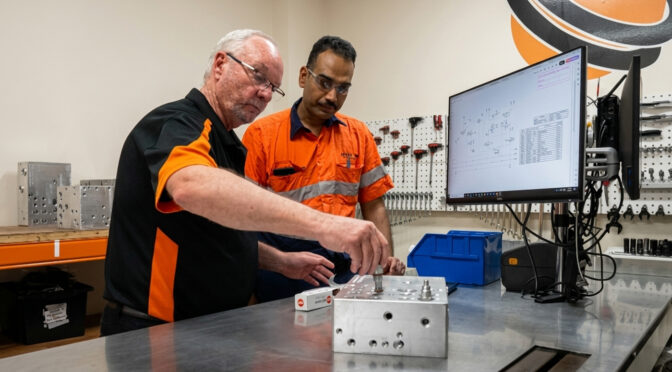
A high-performing hydraulic manifold is not defined by machining alone. Hydraulic performance is influenced long before manufacturing begins through engineering expertise, application knowledge and robust system design. Flow paths, valve selection and function integration are considered as part of the complete hydraulic system, ensuring the finished manifold performs as intended under real operating conditions.
At Custom Fluidpower, engineering and precision manufacturing work together to preserve that design intent from concept through to production.
Performance Defined Through Design
Hydraulic performance is not something that can be adjusted after installation.
It is defined through system design—from flow path routing and function integration to overall layout and application requirements.
At Custom Fluidpower, every manifold is engineered with a focus on how it will perform in operation, not simply how it will be manufactured. By combining engineering expertise with precision manufacturing, the original design intent is maintained from concept through to production.
Performance isn’t added later. It’s engineered into the system from the very beginning.
Learn More
To learn more about Custom Fluidpower’s system design and integration capability:
https://www.custom.com.au/
If you have other questions regarding how the Custom Fluidpower team can optimise hydraulic performance in your operation, send your question to the team using this form.